
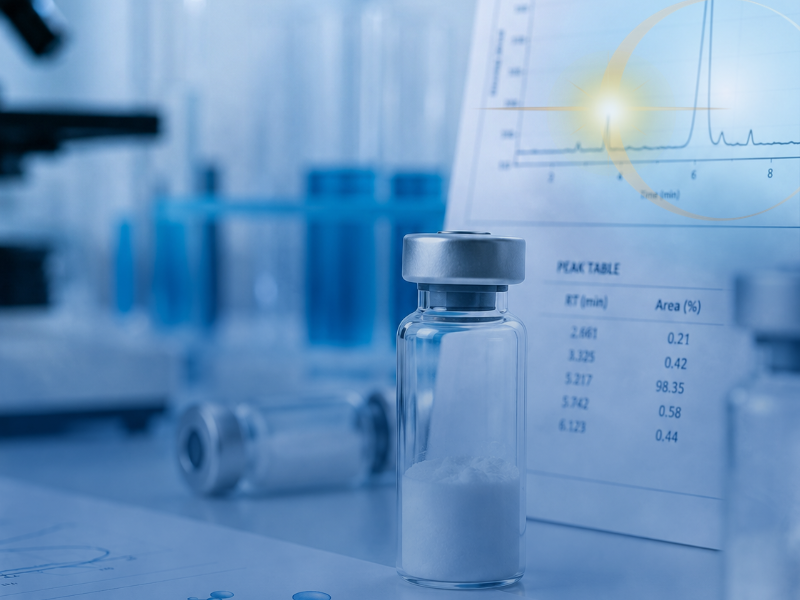
When researchers tested semaglutide bought from unregulated online sellers, labels promised 99% purity. Measured purity ranged from 7.7% to 14.37%. In a separate analytical study, vials of melanotan II labelled as 10 mg each held between 4.32 and 8.84 mg.
A label is a claim. Peptide identity and purity testing is how a lab checks it, by asking two separate questions: is this the right molecule, and how much of the sample is that molecule? A vial can pass one and fail the other.
Below: the main methods, what purity percentages measure, and how to read a certificate of analysis (COA).
Quick answer: how do researchers assess peptide identity and purity?
Researchers use HPLC to measure what share of a sample is the main peptide, and mass spectrometry to confirm its molecular weight and sequence. Orthogonal methods, such as amino acid analysis, qNMR and counter-ion testing, fill the gaps both leave open.
Identity vs Purity: Two Different Questions
Identity asks whether the sample is the right molecule: the correct amino acids, in the correct order, with the correct modifications. Purity asks how much of the sample is that molecule, and what else is present.
The two can come apart. A sample can show one clean peak on a chromatogram and still be the wrong peptide if nothing checked its mass, because a clean peak only says the sample is uniform. And the right peptide can arrive mixed with close relatives of itself, such as shortened or modified versions of the same sequence. In an analytical study of a synthetic human C-peptide material, metrology researchers at the International Bureau of Weights and Measures (BIPM) and China’s National Institute of Metrology identified and quantified more than 65 structurally related impurities.
Both questions are answered by comparison against a characterised reference material, covered in Why Reference Standards Matter in Peptide Research.
How Is Peptide Purity Measured?
The main tool is HPLC (high-performance liquid chromatography): a sample is pushed through a packed column, molecules travel at different speeds, and a UV detector records each as it leaves. Purity is usually reported as area percent: the main peak’s area divided by the total area of all detected peaks.
Area percent rests on an assumption. A method study on absolute peptide quantification points out that it assumes UV absorbance is uniformly proportional to mass, so the result may be only semi-quantitative.
So labs add orthogonal methods: independent techniques that measure a different property, so their errors are unlikely to overlap.
- Amino acid analysis: counts the amino acids after breaking the peptide down.
- qNMR (quantitative nuclear magnetic resonance): measures the intact peptide against an internal standard.
- Mass balance: subtracts every measured impurity, including water and salts, from 100%.
What Does 98% Peptide Purity Mean?
On most COAs, 98% purity means the main peak makes up 98% of the total UV peak area on an HPLC chromatogram. It does not mean 98% of the powder’s weight is the target peptide.
What the other 2% can be
Usually, structurally related impurities. An analytical study of thymalfasin materials found 23 related impurities, including amino acid deletions and insertions, dimers and isomers. In teriparatide, six deletion impurities appeared only in chemically synthesised material.
What the number leaves out
Net peptide content is the share of total weight that is actually peptide. HPLC purity misses components that never appear in the calculation:
- Water held by the freeze-dried powder.
- Counter-ions: charged molecules such as trifluoroacetate (TFA), acetate or chloride that pair with the peptide as a salt. In the angiotensin II study, TFA made up nearly 25% of the material by mass.
Counter-ions need their own tests; in a method comparison study, ion chromatography measured them best.
How to Confirm Peptide Identity
Mass spectrometry (MS) weighs molecules by turning them into charged particles and measuring their mass-to-charge ratio, confirming whether the main peak has the expected molecular weight.
Mass alone is not proof, since different sequences can share one. Tandem mass spectrometry (MS/MS) breaks the peptide into fragments whose masses reveal the amino acid order. In the melanotan II validation study, identity was confirmed only when the retention time (how long a peptide takes to pass through the column) and five fragment ions all matched.
Why chiral purity matters
Most amino acids are chiral, existing in two mirror-image forms, L and D. A D-form impurity has the same mass as the L-form peptide, so standard MS cannot separate them. A 2024 review describes racemisation, the conversion of one form into the other, as one of the most common side reactions in peptide chemistry. In one analytical study, finding low-level D-isomer impurities in semaglutide required hydrolysis and chiral derivatisation.
HPLC vs Mass Spectrometry Peptide Testing
HPLC and MS answer different questions, so labs pair them, often in one setup called LC-MS.
Each covers the other’s main blind spot, though not completely, so results from both are read together. In a 2D-LC-MS study of peak purity in pharmaceutical peptides, researchers note that compounds with the same mass-to-charge ratio are not readily told apart by MS, so they must be separated chromatographically.
For a deeper look at both techniques, read HPLC and Mass Spectrometry in Peptide Characterisation.
What Testing Can Miss, and How to Read a COA
- Co-eluting impurities. In a 2D-LC study of peptide quality control, researchers note that closely related impurities can co-elute (leave the column together) with the main peak in a standard HPLC run.
- Undeclared impurities. In an analytical study of the peptide Cbf-14, researchers identified 33 related impurities not declared in custom synthetic peptides.
- Label gaps. When researchers tested semaglutide bought from unregulated online sellers, measured purity fell far below the 99% printed on the labels.
What a COA should show
- A batch number that matches the vial.
- The HPLC trace, not just a percentage.
- An MS result comparing observed and expected molecular weight.
- The test date and testing laboratory.
- Methods used, and ideally net peptide content or counter-ion data.
See these elements on a real document via the OHR COA page. A COA documents research quality only, not suitability for any use outside the laboratory.
Frequently Asked Questions
Is HPLC enough to confirm a peptide?
No. HPLC shows how much of a sample sits in the main peak, but it does not measure mass, so it cannot confirm the peak is the right molecule. Labs pair it with mass spectrometry, as in the melanotan II validation study.
What is net peptide content?
It is the percentage of a sample’s weight that is actually peptide, after accounting for water, counter-ions and other non-peptide material. It is usually lower than HPLC purity: in one reference material study, TFA alone made up nearly 25% of the mass.
What is a TFA salt?
Trifluoroacetic acid (TFA) is a standard ingredient in peptide HPLC, so many synthetic peptides carry trifluoroacetate as their counter-ion. In a method study, freeze-drying from hydrochloric or acetic acid removed TFA to satisfactory levels, leaving chloride or acetate salts.
Why can two COAs for the same peptide show different purity?
Different columns and conditions resolve impurities differently, so related impurities may co-elute under one method but not another. Impurity profiles also depend on how a peptide was made. When comparing COAs, check the methods, not just the headline numbers.
Closing
Reproducible research starts with knowing what is in the vial: the right molecule, in a known amount, with impurities on record. For researchers sourcing materials with batch-level COAs, explore the OHR research catalogue.
Further reading: HPLC and Mass Spectrometry in Peptide Characterisation.
This content is for informational and educational purposes only. Products referenced are intended for laboratory research use only and are not for human or animal consumption.